Chapter 1. Setting the Stage
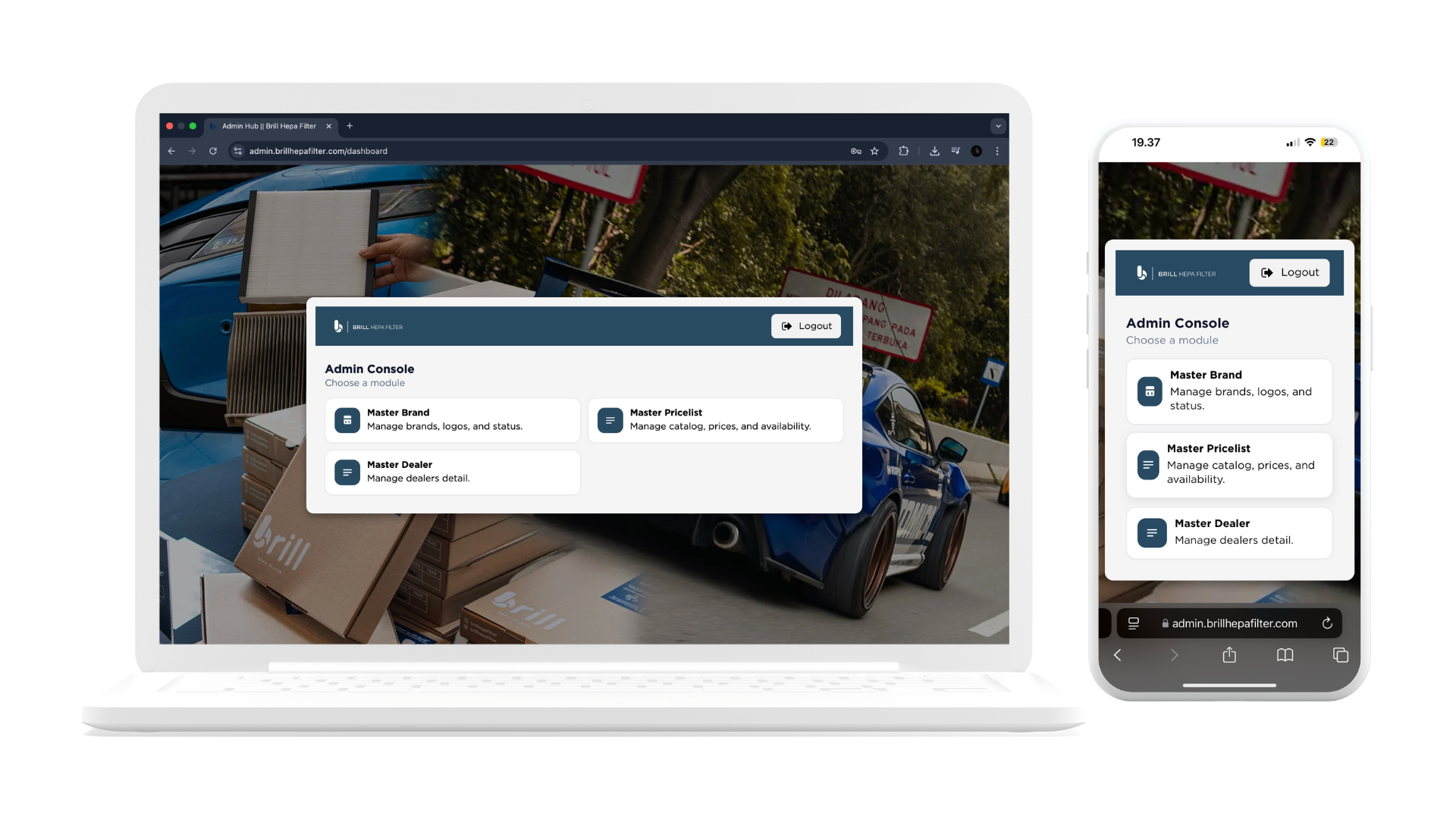
Brill Admin Platform was developed as an internal system to manage core business data for the brand, including product records, dealer information, and brand-related content. The project focused on building a structured mini-MVC architecture in PHP so the admin side could scale more cleanly as new modules were added.
This work was delivered in collaboration with Media Team and Direct Client.
Chapter 2. Carrying the Work
Responsibilities in this project included System Architecture Design, Routing and Controller Development, Database Modeling, Admin Interface Development, Authentication and Session Handling, and CRUD Module Development.
Chapter 3. What Changed
This project resulted in a modular internal admin platform with clearer separation between routing, controller logic, and data access. Instead of relying on scattered page-level logic, the system was organized into reusable modules that supported maintainability, future feature growth, and more consistent internal operations.
Chapter 4. The Problem and the Response
Problem
As the Brill product ecosystem grew, internal management tasks such as maintaining product data, dealer information, and brand records needed a more organized system. Using isolated pages or ad-hoc logic would make future maintenance harder, especially when multiple modules had to share similar patterns for validation, data retrieval, and updates.
Solution
The solution was to build a custom mini-MVC admin platform in PHP with a front controller, modular controllers, and model-based data access using PDO. My contribution focused on designing the structure, implementing the modules, and making the admin flow easier to extend as the brand operations expanded.
Chapter 5. How It Was Built
The admin platform was designed as the internal backbone for Brill operations. It handled day-to-day data maintenance for products, dealers, and brand information through a custom PHP structure. Compared to a simple CRUD page collection, this implementation emphasized modularity, session protection, and cleaner organization between routing, business logic, and data access.
Implementation Flow: Authentication and session handling are implemented to protect internal pages and support controlled admin access. Model and database access logic are connected through PDO-based abstraction to keep data operations more structured. The system is refined through iterative updates so new modules can be added with minimal structural changes.
Implementation details included Custom mini-MVC architecture using PHP, Front controller routing for admin pages and module endpoints, Session-based authentication and protected admin access, Modular CRUD development for product, dealer, and brand management, PDO-based database abstraction for cleaner data handling, and Internal dashboard structure prepared for future module expansion.
Some screens and implementation details have been intentionally generalized because this was an internal enterprise project.
Chapter 6. Application Flow
Primary Flow: Core admin requirements are mapped first, including product data, dealer data, and brand data that need to be managed from one internal system. A front controller routing pattern is prepared so each admin action can be directed into the correct page or module handler. Dedicated modules are built for product, dealer, and brand management so each feature has clearer boundaries and reusable structure.